AI location intelligence

From thousands of locations to your shortlist. In days.

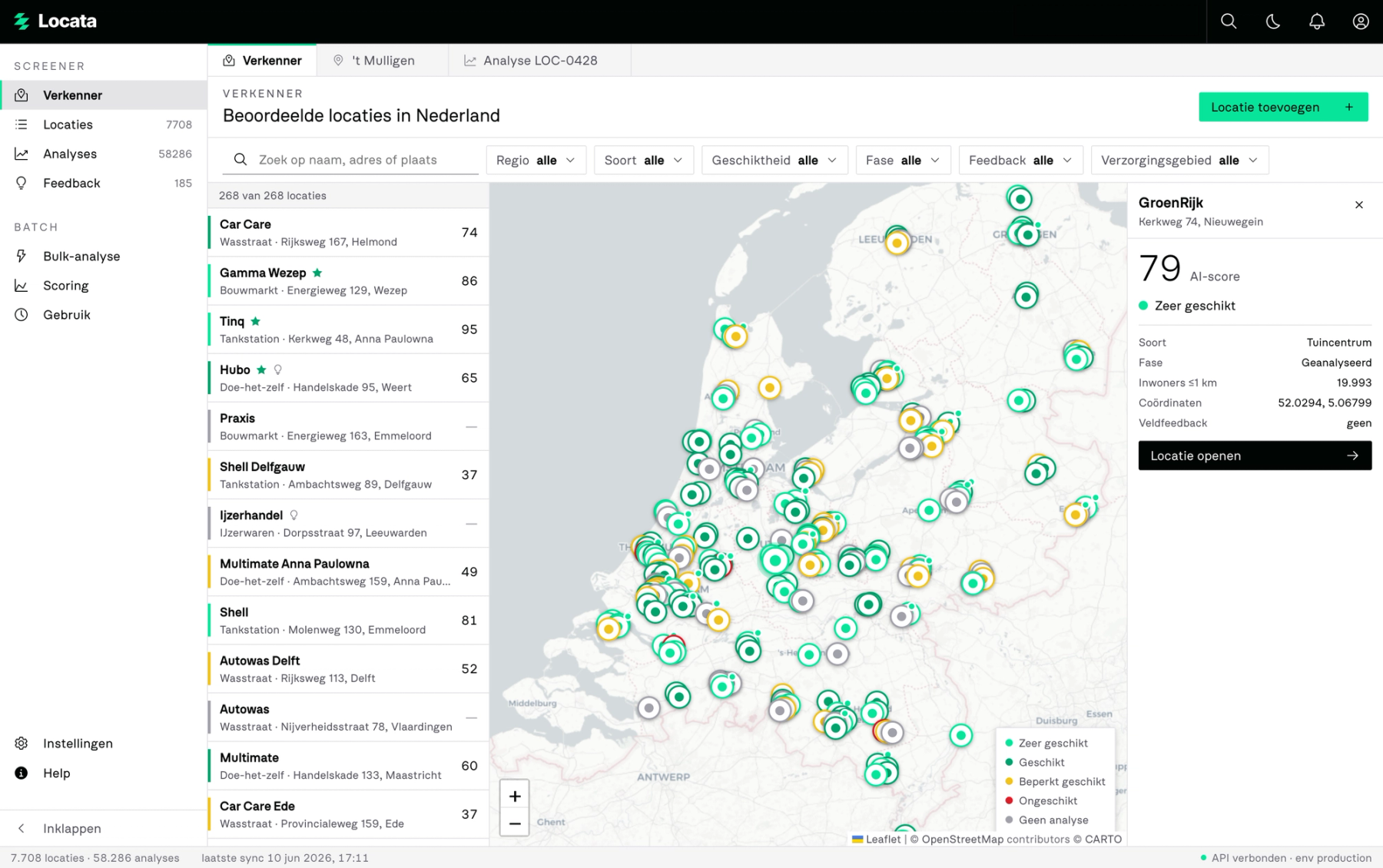
Locations enriched with European public data sources. Analysed by multiple AI models on patterns, potential, and opportunities. For faster, defensible decisions. At scale.

analyzing0coordinates / min

Works with

ClaudeGPTGeminiMistralKadasterBAGBGTNDWPDOKBedrijfsdata.nlOpenStreetMapGoogle MapsClaudeGPTGeminiMistralKadasterBAGBGTNDWPDOKBedrijfsdata.nlOpenStreetMapGoogle Maps

How it works

Four steps, repeatable across every sector.

Read the full methodology
  1. 01

    Define your set

    Upload candidates or define them by criteria — e.g. all gas stations in a region, all parcels over 500 m² in a congestion zone.

  2. 02

    We enrich automatically

    Cadastral records, demographics, traffic, infrastructure, Street View, web data — standardized per location.

  3. 03

    Multiple AI models score in parallel

    Claude, GPT, and Gemini evaluate against your prompt. Disagreement signals locations that need human review.

  4. 04

    Shortlist with reasoning

    A ranked list with evidence per location, ready for permitting, internal approval, or stakeholder review.

Why Locata

Three things that hold up under scrutiny.

01

Insight

Decisions based on better insights.

Three AI models score every location against your criteria. Where they agree, the call is robust; where they diverge, you see exactly which candidates need human judgement — not a black-box rank, but evidence per location.

02

Speed

From thousands of candidates to a shortlist in days.

What takes months by hand runs in a sprint. Fast enough for tender deadlines, council cycles, and competitive markets where the first credible proposal wins.

03

Efficiency

More candidates scored, less work per candidate.

Locata doesn't replace expertise — it scales it. The same pipeline runs across 100 or 10,000 candidates with consistent depth, without growing team headcount linearly.

Live · scoring run

Bulk return machine candidates · NL

Gas station 0421 · Utrecht943/3
Transfer station 18 · Almere893/3
Roadside hub · Eindhoven873/3
Petrol plaza · Breda712/3
Service area · Zwolle582/3

Schematic preview · indicative only

Case study

Statiegeld Nederland.

From 1,000+ gas-station and transfer-station candidates to a 100-location shortlist for bulk return machines. Scouting time reduced from months to weeks. The methodology now extends across every adjacent collection category.

Candidates evaluated
1,000+
Shortlist size
~100
Time to shortlist
3 weeks
Scouting reduction
10×

FAQ

Common questions about Locata.

  • What is Locata?

    Locata is an AI-powered location intelligence platform that scores thousands of candidate locations against custom criteria. Three frontier models (Claude, GPT, Gemini) run in parallel against European public data — Kadaster, BAG, BGT, BRO, NDW, PDOK — to produce a ranked shortlist with reasoning per location.
  • Who uses Locata?

    Grid operators (Liander, TenneT, Stedin, Enexis) for substation and transformer siting; EV charging operators (Fastned, Allego, Powerdot) for charge point placement and concession bids; Statiegeld Nederland for bulk deposit return machine rollout; municipalities and consultancies for shared mobility hub networks; and retail chains like McDonald's for new-store site selection.
  • How is Locata different from Placer.ai, CARTO, or Esri?

    Locata is purpose-built for European infrastructure rollouts, not US retail foot-traffic analysis. We run multi-model AI scoring instead of single-vendor confidence, integrate natively with Dutch and EU public data sources (Kadaster, BAG, BGT, NDW, PDOK), and ship per-location reasoning that holds up in ACM consultation and municipal council review — not just a heatmap.
  • What data does Locata enrich each location with?

    Cadastral records (Kadaster), buildings and addresses (BAG), large-scale topography (BGT), subsurface registry (BRO), traffic intensity (NDW), national geo-portal (PDOK), CBS demographics, grid operator public capacity indicators, Google Street View, aerial orthophotos, OpenStreetMap, and per-vertical sources like RDW EV density or municipal plankaarten. All enrichment is standardised across candidates, so locations are comparable on the same axes.
  • How fast is a Locata engagement?

    A typical pilot delivers a scored shortlist in two to three weeks from kickoff — week one for prompt definition and data integration, weeks two-three for the scoring run and reasoning review. Ongoing subscriptions support continuous evaluation as new candidates emerge across investment-plan or expansion cycles.
  • How much does Locata cost?

    Pilot engagements start at €15,000 fixed-scope, fixed-price. Ongoing subscriptions start at €2,500/month with quarterly refresh cadence. Enterprise engagements for grid operators and major retail chains are scoped per program — talk to us about scope, integration, and timing.
  • Is Locata GDPR compliant?

    Yes. All processing happens under GDPR with EU data residency. Customer candidate sets, scoring prompts, and outputs are never used to train public AI models — inference only, audit-logged. ISO 27001-aligned processes, available DPA, sub-processor list provided per engagement.
  • Can Locata integrate with our internal GIS?

    Yes. Locata exports to GeoJSON, CSV, PDF, and a REST API. We integrate with ESRI/ArcGIS, FME, internal asset-management systems (Maximo, IFS), and project-portfolio platforms via export or API. Your single source of truth stays where it is — Locata feeds it.

Get in touch

What would you scan?

Tell us about your rollout — the candidate set, the criteria, the deadline. We'll get back within one working day.

Sample run on your data within 5 working days

EU-resident, GDPR-compliant by default

No obligation, no contract until pilot

By submitting, you agree to our privacy policy.